Winning and keeping new singers: how your choir becomes a member magnet
Updated August 13, 2026
•

Janina Moeller
Choir director since 2010Last autumn I stood in front of my pop choir and counted through: 14 sopranos, 11 altos, three basses – and exactly two tenors. One of them had just resigned because he had to relocate for work. The other went pale on the spot. "Does that mean I'm now … the entire tenor section?" he asked. I nodded. He swallowed. And then he sang anyway, bravely and astonishingly loudly.
Many choirs in Germany are in a similar position. But there's more reason for hope than you might think.
The starting point: challenging, but not hopeless
Let's take an honest look at the numbers first. Not to spread panic, but to understand where the lever is.
In Germany there are around 54,000 choirs, and the vast majority of them are actively looking for new members (Deutsches Musikinformationszentrum / miz.org). The structures are there, the rehearsal rooms are there, the passion is there. What's often missing are the strategies for reaching new people and keeping them.
At the same time, clubs and societies all over Germany are feeling the shift in society: less time, more competition from other leisure activities, changing life plans. The Stifterverband has pointed out that between 2006 and 2016 more than 15,500 clubs in rural regions dissolved (Stifterverband, 2018). And then came COVID: for choirs, whose very existence is built on singing together in enclosed spaces, the pandemic was a particularly hard blow. Many choral societies that had to pause in 2020 never came back together afterwards. The good news: the Stifterverband sees digitalisation and modern club management as the most effective answer to this trend.
Why tenors and basses in particular are so hard to find
The cliché of the missing tenor is unfortunately more than a joke. By now many pieces are available in SAB arrangements (soprano, alto, baritone) that replace the classic SATB setting – a pragmatic solution for choirs where splitting into tenor and bass simply isn't realistic any more.
Why? For one thing, the natural voice type of most men lies more in the baritone range; genuine tenors are simply rarer. For another, choir singing has an image problem among men in many regions. The classic male voice choir is struggling in a lot of places, and young men often don't find their way into mixed choirs at all – not yet.
A little anecdote: one of my tenors once told me how he came to the choir. His best mate simply dragged him along after work: "Come with me, we need men, and afterwards we'll go for a beer." He didn't really want to, but he went along. Three years later he's still singing – and has since brought two friends of his own. Personal invitations are and remain the strongest recruiting channel for men's voices.
Because the potential is huge: they're out there, the people who love to sing. More than 16 million people in Germany make music in their free time (Deutscher Musikrat). The choir just has to offer them the right way in.
What science knows about choir singing (and why that helps with recruiting)
Before we talk about onboarding strategies, a quick look at the research. It provides the best arguments you can use in your next "we're looking for new members" campaign.
The ice-breaker effect
A widely cited study from the University of Oxford (Pearce et al., 2015) showed that singing groups build social bonds considerably faster than other creative group activities such as writing or crafting. The researchers call this the "ice-breaker effect": singing together creates a sense of community across the whole group in one go, not just between individual people (Royal Society Open Science).
That's worth its weight in gold for recruiting. Because it means: anyone who joins in once and sings feels a sense of belonging faster than in almost any other club activity.
And that's exactly why it pays to strengthen the community outside of choir rehearsal as well. You don't need big events for that – sometimes sitting together after rehearsal, a drink and a relaxed chat are enough to turn fellow singers into real friends. People who feel connected not just musically but also personally are the ones who stay.
Singing makes you happy – and strengthens the immune system
Singing together releases not only endorphins, serotonin and dopamine but, unlike solo singing, also oxytocin, the so-called "bonding hormone" (Schladt et al., 2017, Frontiers in Human Neuroscience). In addition, a study by Kreutz et al. (2004) demonstrated that choir singing increases the concentration of immunoglobulin A (S-IgA) – an important marker for immune defence (Journal of Behavioral Medicine).
In the UK, community choirs are now even prescribed by the National Health Service (NHS) as part of "social prescribing", among other things for loneliness, depression and anxiety disorders (Fancourt & Finn, 2019, WHO Europe).
Choir singing keeps the brain fit
More recent studies (2023/2024) show that choir singing promotes structural connectivity in the brain and can counteract age-related cognitive decline (PMC, 2024). A two-year long-term study confirms positive effects on cognitive function, mood, quality of life and social engagement , especially in older people (Frontiers in Human Neuroscience, 2023).
Takeaway for your recruiting: choir singing is demonstrably good for body, mind and soul. Those are strong arguments, not just for the flyer, but also for the personal conversation when someone says: "Oh, I don't know if that's really for me."
Why the first impression decides everything
Now let's get concrete. So you've convinced someone to drop by a rehearsal. Congratulations, that's half the battle. But now comes the other half, and it's at least as important: onboarding.
From the world of work we know: a structured onboarding can increase retention by up to 50 percent (Harvard Business Review, 2022). That applies to companies, but the principle transfers directly to clubs and societies. People stay where they feel welcome, oriented and involved.
As important as that sounds, it's rarely put into practice. In many choirs, newcomers turn up for their first rehearsal, get a folder of sheet music pressed into their hands and have to work out the rest for themselves. No wonder many of them disappear again after the trial period. The choirs that shape their onboarding deliberately are the ones making the decisive difference here. It doesn't take an elaborate process – just a bit of empathy for what that first evening feels like for someone new.
5 strategies for onboarding that wins new members over
1. Make getting started as easy as possible
Sounds banal, but it isn't. The biggest hurdle for new singers isn't the singing, it's orientation. Where do I sit? Which sheet music do I need? What are we practicing today? Is there a chat I need to join? And nothing puts people off more than the chaos of WhatsApp groups, email lists, Google Drive folders and handwritten rehearsal schedules. If you have to open three different apps and ask two people to find out when the next choir rehearsal is, then you have a problem.
One central platform for everything brings order to this. No hunting for a sheet music folder, no "ask Lisa, she's got the music". In practice, newcomers often only get their digital access after the trial period, once membership becomes official. Some choirs bridge that time with a detailed welcome email that bundles all the important information, dates and contact details, so new singers feel looked after from the very start. As soon as membership is settled, getting started with a choir app is all the quicker: new members join via a simple invitation link and have immediate access to repertoire, calendar and announcements.
2. Give new members a go-to person
The best app in the world doesn't replace the feeling of being personally taken under someone's wing. A simple buddy system works wonders: an experienced choir member looks after the newcomer during the first few weeks. Sits next to them, answers questions, maybe goes for a drink together after choir rehearsal.
That sounds old-fashioned, but it's one of the most effective levers against quiet disappearance. Because anyone with a personal connection in the choir comes back even when their motivation dips.
3. Give new members tools to catch up
The biggest fear of new choir members? Not being able to keep up. The choir has been rehearsing a piece for weeks, and as a newcomer you're just supposed to sing along? That's like jumping onto a moving train.
This is exactly where practice recordings help, letting new members prepare at home. The choir app cori goes a step further than simple MP3s: with a built-in audio mixer, singers can turn their own voice part up and the others down, adjust speed and pitch and repeat difficult passages in a targeted way.
You'll find more on how to get the most out of practice recordings in our article "Practice recordings that really get used".
4. Rely on feedback instead of gut feeling
Many singers, especially beginners, have no idea whether they're singing correctly. They hear themselves in the choir's blend of sound and hope for the best. That's frustrating and unsettling at the same time.
While practicing, cori offers visual feedback on pitch and rhythm: singers see in real time whether they're hitting the right note, and can track their progress over time. For beginners in particular that makes an enormous difference, because they're no longer groping in the dark but can see concretely what's already solid and where they still need to practice.
5. Use gamification to keep people going
The first rehearsal was great, the second one too. And then it becomes routine.
Streaks and challenges are an underrated tool here. Apps like cori offer the option of setting weekly challenges – for example "practice Bohemian Rhapsody 3x" or "listen to every piece for the next choir rehearsal at least once". That creates small moments of success and a sense of connection: we're all practicing together, even if everyone is sitting at home.
For beginners especially this is valuable, because they quickly get the feeling: I belong here, I'm contributing, my effort counts.
What young people expect from a choir
Young people are keen on community, but on their own terms. The Deutsche Chorjugend put it well: younger people want to help shape things, they want flexible structures instead of rigid hierarchies, and they expect a digital presence that goes beyond an outdated website.
The encouraging part: much of this can be implemented with just a few adjustments:
- A low-threshold way in: no compulsory audition, but open trial rehearsals
- Digital tools: people who organise everything on their phone in daily life expect that from the choir too
- Visible progress: younger singers want to know whether their voice training is improving. Feedback tools help enormously here
- Project-based participation: not everyone wants to commit for a year straight away. Some come for a concert project and then stay because it's fun
Recruiting men's voices deliberately: strategies that work
At the beginning we talked about the tenor problem – but how do you actually get more men into the choir? Here are approaches that work in practice:
- Personal invitations instead of notices: by far the most effective channel. Ask your existing men's voices to approach friends, colleagues or acquaintances directly.
- Targeted outreach in the right places: company sports groups, regulars' tables, football clubs – go where men are already active in groups and make a low-threshold offer
- A project-based way in: many people shy away from a long-term commitment. A concrete concert project over 8–10 weeks lowers the barrier enormously. Once people are in, they often stay
- Avoid the word "choir": sounds paradoxical, but it works. "We're doing a pop project" or "we sing rock classics" appeals to a different audience than "join our choir"
- Targeted advertising with repertoire: show in your advertising what you sing. Some people are more easily won over when they know the repertoire: "Bohemian Rhapsody" or "Africa" sounds more attractive than "we rehearse on Thursdays"
- Make role models visible: videos and photos in which men are visibly singing with enthusiasm break down prejudices.
Tip for choir directors specifically looking for men's voices: communicate it openly. A "we're specifically looking for tenors and basses" on your website and social media isn't a rejection of women, it's a clear signal that speaks to exactly the right people.
Going digital as a growth opportunity for choirs
A study by neuland21 and the Leibniz Institute (2021–2023) shows: digital tools have arrived in club life – but they're far too rarely used deliberately for attracting new members. The technology is used for administration, not for enthusiasm. And yet that's exactly where the greatest potential lies.
Because digital tools don't just make choirs more efficient, they also make them more attractive. A choir that's professionally organised, that hands beginners practice tools and that communicates in a modern way comes across as inviting. Word gets around.
Going digital works – above all for member retention
When it comes to digitalisation, many choirs first think of attracting new members. But the real lever lies elsewhere: in keeping them. Because most members don't leave because of an argument or bad music – they quietly disappear because everyday life gets in the way. One missed rehearsal becomes two, then three, and at some point coming back feels awkward.
Digital tools work precisely at this point. Anyone who stays connected to the choir between rehearsals via an app – whether through the shared calendar, a quick reminder about the next rehearsal or the option of catching up on missed pieces at home – doesn't fall behind so easily. The connection to the choir doesn't stop after rehearsal, it stays present in everyday life without being intrusive.
And then there's progress: people who practice regularly and can see their own development stay more motivated. Anyone who goes from rehearsal to rehearsal and is never sure whether they're keeping up gives up at some point. Practice tools, feedback and challenges make sure members feel: I'm getting better, and the choir notices it too.
How going digital changes how your choir comes across
That outward impression is often underestimated. A choir that's digitally organised comes across not only as modern but also as reliable, well run and lively. Those are exactly the qualities people look for when they're choosing a new hobby. Younger people in particular, used to organising everything on their smartphone, expect this standard. And it makes a difference for older newcomers too: less organisational chaos means fewer barriers to getting started.
What this means for your choir in concrete terms
For choirs, this means in practice:
- Digitalise onboarding: invitation links instead of slips of paper or email ping-pong
- Maintain the connection between rehearsals: shared calendars, practice reminders and one central communication channel make sure members don't drop off the radar
- Become visible: a choir that's well set up digitally is easier to find online and immediately comes across as more professional and inviting to interested people
- Enable practicing, not just organising: practice recordings and feedback tools so members can keep at it independently at home
If you want to know which category of app suits your choir, read our guide to choosing the right choir app.
The most common hurdles – and how to clear them out of the way
Not everyone will stay, and that's okay. But if someone is hesitating, it's worth asking why. Because often the reasons are surprisingly small and solvable:
- "I didn't dare say that I can't read music" → Solution: practice recordings mean reading music isn't a prerequisite
- "I never really connected with the group" → Solution: buddy system and shared challenges
- "I always forgot to practice" → Solution: practice reminders and motivational support
- "There was too much organisational chaos for me" → Solution: one central tool for sheet music and dates.
Most of these hurdles can be cleared out of the way with well-thought-out onboarding and the right digital tools. Sometimes one small change is all it takes to turn a trial guest into a long-standing member.
Summary: what you can do today
- Review your onboarding process: what does the first evening feel like for someone new? Ask former trial guests or new members.
- Give new members tools to catch up: practice recordings with digital learning aids.
- Use gamification: small challenges keep motivation up, even between rehearsals.
- Talk about the benefits: choir singing makes you happy, strengthens the immune system and creates community. Those are convincing arguments.
- Approach men's voices deliberately: personal invitations, project-based ways in and targeted outreach where men are already active.
Choirs are one of the oldest and most beautiful ways to experience community. And the people out there are looking for exactly that: choir community, fun, a shared project. With the right approach and the right tools you can offer them exactly that and let your choir grow.
Want to see how cori can simplify onboarding for your choir? Try cori free for 30 days and experience how newcomers settle in faster and enjoy staying.
Get your choir ready for the future
So you can concentrate on what matters most: the music.
Share this article
More Articles
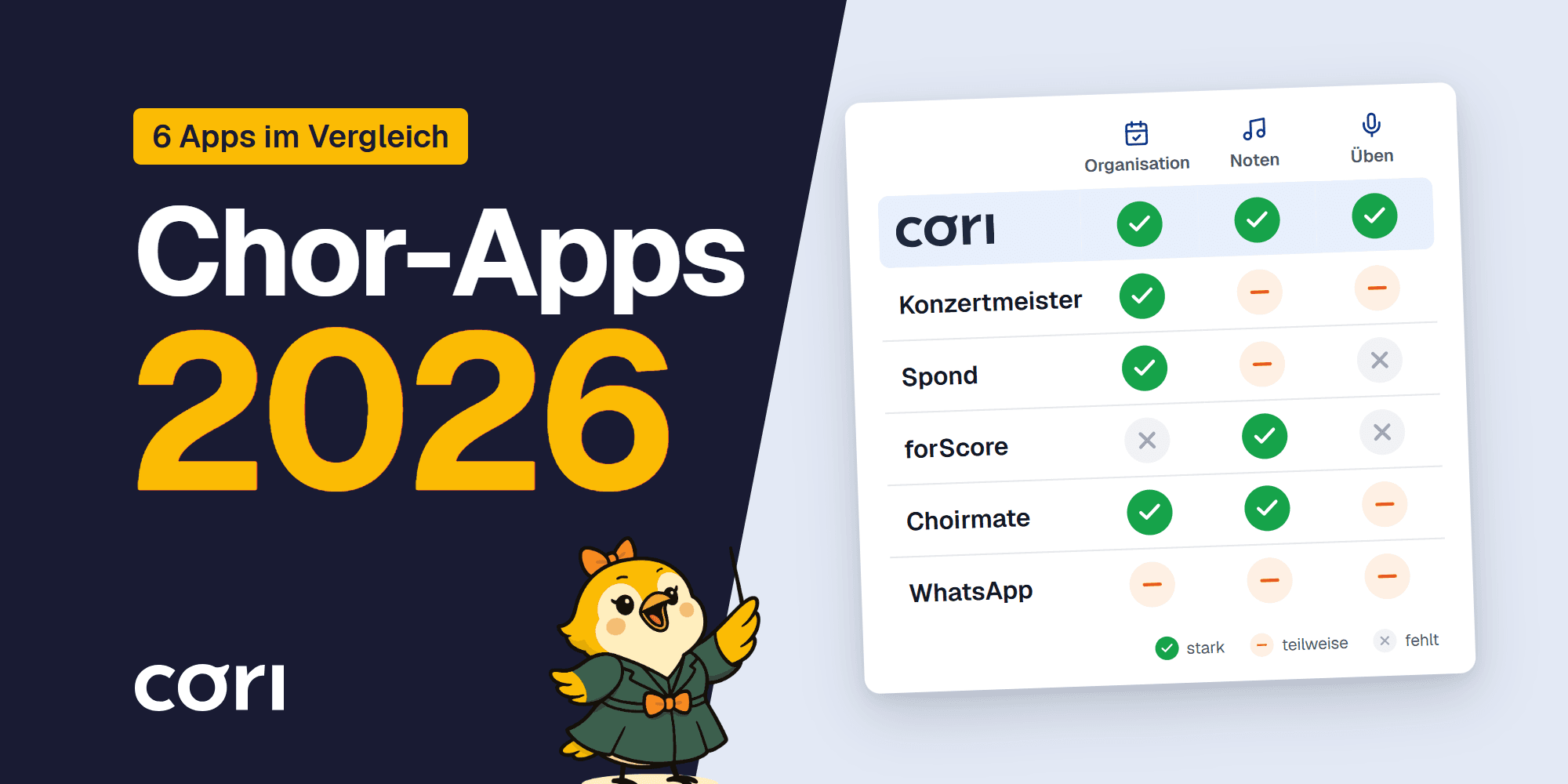
Choir Apps 2026 Compared
Choir apps 2026 compared: from Konzertmeister to cori – which app fits your choir? An honest review with clear recommendations for organization and practice.

The 6K practice room for the 2027 season: now in the browser too
6K UNITED! has opened the 2027 season, and cori's 6K practice room is ready: every song with chapter markers, follow-along lyrics and sheet music, groups and appointments for teachers, and for the first time in the browser as well, with nothing to install. What's new and how you get started.