Finding the Right Choir App: A Practical Guide for Choir Directors and Singers
Updated August 19, 2026
•

Janina Moeller
Choir director since 2010Digitalization arrived in the choir world a long time ago. Where heavy folders of sheet music used to be hauled around and important information got lost in email chains, modern choir apps now promise relief. But the choice is huge, and not every app fits every choir.
I still remember the moment three years ago exactly. About six weeks before the concert, a third of my pop choir still had audible trouble finding their way around the melody and the lyrics. The practice recordings I had specially made were barely used because the WhatsApp group was "kind of confusing". Something had to change.
After countless trials and test phases and rounds of feedback, five of my seven choirs use choir apps today, and I strongly recommend it to every new choir. Honestly: I can't even remember a time completely without recordings. And I don't understand why not every choir director works this way. With this guide I want to help you find the right solution for your choir.
What do you actually need a choir app for?
Before you start looking, you should first take an honest look at this: what are the biggest challenges in your choir? The answer to that question largely determines which type of app is the right one.
Broadly speaking, choir apps fall into two categories with different priorities:
Administrative apps: organization comes first
These apps focus primarily on administrative tasks. They are ideal if your biggest problems are the following:
- Chaotic attendance lists and constantly asking "Who's coming to the next rehearsal?"
- Appointments that get lost in various email distribution lists
- No central place to store organizational documents
- Difficulties managing costs and membership fees
Administrative apps such as Chorus Connection or Choir Genius offer scheduling, attendance tracking, member management and simple communication tools. They can have their place, especially for larger choirs with complex administrative structures.
Musical apps: rehearsal quality and musical preparation in focus
These apps put the emphasis on the musical work itself. They are the right choice if the following challenges are the pressing ones:
- Singers turn up to rehearsal unprepared and don't know their voice part
- Rehearsal time is spent learning the notes instead of on musical detail
- Sheet music isn't always available or exists in several versions
- Markings and annotations in the sheet music get lost
- Singers find it hard to practice difficult passages on their own and learn them by heart
The worst thing for me as a choir director is when we start a new song at the beginning of the year and I haven't prepared any practice recordings yet. That rehearsal is about as demotivating as it gets – for me and for the singers. Everyone is unsure, nobody knows their voice part, and we hardly get anywhere. With the right app and prepared recordings, that has thankfully become rare.
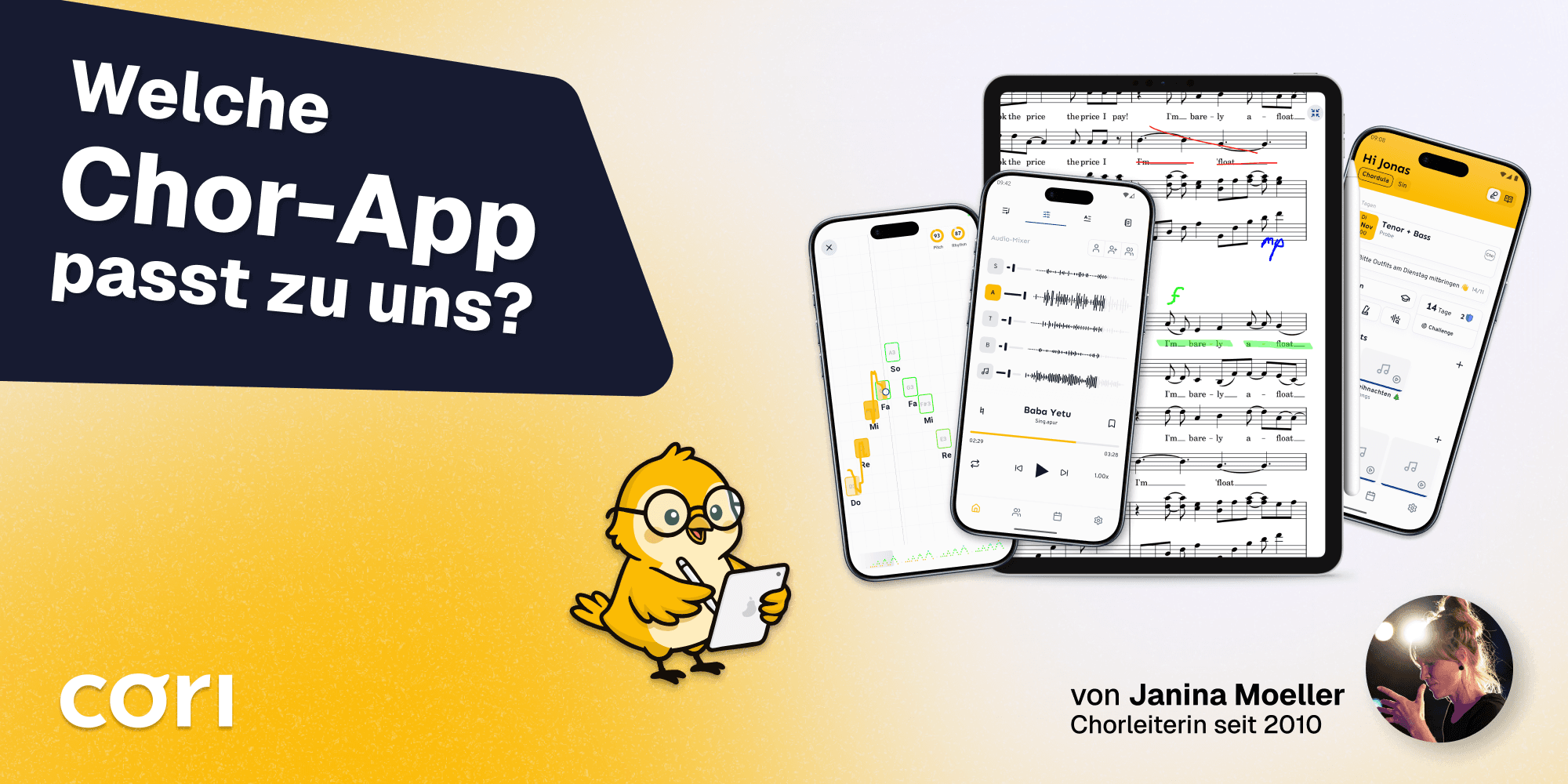
Musical apps such as cori offer extensive features for musical work: digital sheet music with personal markings, part-specific practice recordings for learning independently, functions for adjusting the tempo and looping difficult spots, and often recording functions for rehearsals too. Some go even further and offer interactive vocal exercises and guided Learning Paths that singers can use to train musical fundamentals such as ear training. On top of that they frequently cover basic organization functions as well – but their main purpose is improving rehearsal quality.
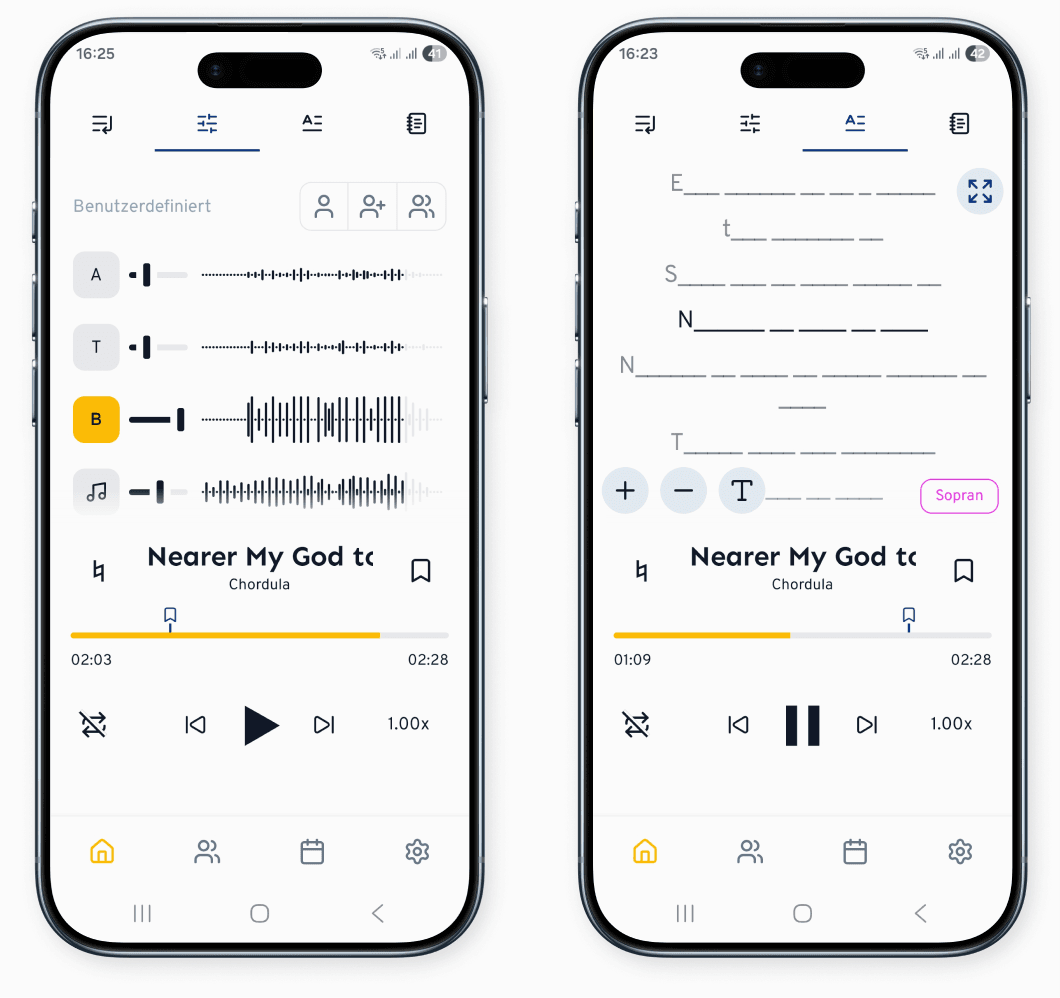
With my first choir on cori I experienced the difference myself: after we switched to cori and to working with practice recordings, the phase of pure "learning the notes" shrank from an average of 4-5 rehearsals to 1-2 rehearsals. Practice time was massively shortened. Why? Because the singers were already able to work at home with individually adjustable practice recordings and already knew their voice part before we sang together. That allows the choir to move into musical shaping much sooner.
The time you invest as a choir director in good practice material therefore comes back to you several times over. And honestly: working with recordings is absolutely central for me. I can't and don't want to work without it anymore – the difference in rehearsal quality is simply too big.
Singing from memory: the underrated leap in quality
One aspect that often gets overlooked: modern choirs can boost their quality enormously if they sing from memory. Eye contact with the audience, posture, freedom in shaping the music – all of that only works without a folder of sheet music in front of your nose.
The problem: choir rehearsals alone usually aren't enough to learn things by heart. This is where the value of good practice tools shows again. When singers can practice their voice parts purposefully at home, learning by heart suddenly becomes realistic. Only with an app that genuinely enables independent practice does this leap in quality become possible. cori also offers dedicated support for memorizing.
Checklist: what does your choir really need?
To make the right decision, you can work through this checklist.
Sheet music and musical content
Do we need a central, digital place to store sheet music for all choir members?
Do singers want to be able to add their own markings and annotations to their sheet music?
Is it important that all singers can listen to their repertoire?
Does our repertoire contain multi-part passages that need more intensive preparation?
Preparation and learning support
Do our singers often come to rehearsal unprepared?
Do we spend too much rehearsal time simply learning the notes?
Would our singers benefit from practice material they can use at home?
Are there singers who struggle to hold their part and need extra support?
Do we as a choir want to be concert-ready faster, have more time for musical detail and perform better?
Is it our goal to sing from memory and thereby raise the quality of our performances?
If you ticked a lot of boxes in these first two categories, there's a strong case for a musical app. But read on – maybe you need both.
Organization and communication
Do we have problems with scheduling and attendance management?
Does important information get lost in email chains?
Do we need a central system for concert dates, performances and events?
Is member management an administrative effort we want to reduce?
Do we have more than 30 active members and need professional administrative structures?
Technical requirements and usability
How tech-savvy are our choir members? Do we need a particularly intuitive solution?
Should the app also work offline?
Is it important that the app works well on both smartphones and tablets?
Do we have a budget for an app solution or are we looking for free alternatives?
Do we need support in German and GDPR compliance?
Making the right decision
I've done this analysis with a lot of choirs, and in 80% of cases it turned out: the real problem isn't organization.
If you ticked a lot of boxes in the first two categories (sheet music and preparation), then a musical app like cori is probably the better choice. These apps are designed to raise musical quality and efficiency while also offering basic organization functions.
An example from my own practice: my project choir had a purely functional organization app. Appointments perfectly organized, but rehearsals were a struggle. Only when we introduced cori, which the singers actually practiced with, did rehearsal quality noticeably improve and the members audibly had more fun. And having tested many approaches, I'm definitely convinced: for most choirs, an app that puts the music first is the more sensible choice.
With an administrative app: appointments and attendance perfectly organized, but 3-4 rehearsals go into reading notes. Many people are unsure.
With a musical app: singers practice at home and after 1-2 rehearsals most of them know their voice part. You work on dynamics and expression sooner. The concert sounds considerably more confident.
Important: the biggest challenge usually isn't organization (you can plan dates with Doodle too), but the musical preparation of the singers. cori combines both: musical features come first, but scheduling and communication are seamlessly integrated. You don't need two systems. For a detailed look at which admin features cori covers, see the overview of choir management software.
Practical tips for introducing a choir app
Whichever app you decide on, the rollout should be well planned. Here are some proven strategies:
Start with a pilot phase: first test the app with 5-8 tech-savvy people from different voice parts. They can then act as multipliers.
Offer support: schedule an introduction in the last 15 minutes of a regular rehearsal. Less tech-savvy members in particular often just need a first bit of help.
Communicate the benefits clearly: not "the app has an audio mixer", but "you can finally turn up the alto part so you can hear it better."
Be patient: give the choir time to get used to the new way of working. In my pop choir, some members needed four weeks before they were really on board.
Collect feedback: every third rehearsal, briefly ask how the app is going down and whether any problems have come up.
Thinking about cost: is the investment worth it?
A management app often costs €12-25 a month, a musical choir app like cori more like €15-35 (depending on choir size).
If your choir rehearses two hours a week and the app saves you 30 minutes per rehearsal (which is the case for me), that's 26 hours a year, so 13 extra rehearsals. That's the equivalent of a whole additional program.
Common concerns
"Our older members aren't tech-savvy." My two 70+ singers were the keenest users after a short introduction. Motivation matters more than affinity for technology.
"We don't need this." Hobby choirs benefit too. More time for music instead of reading notes = more fun.
"It's too complicated." Modern apps are simpler than WhatsApp groups with audio files scattered everywhere and Drive links nobody can find.
Conclusion: the best app is the one that fits your goals
There is no single perfect choir app for everyone. The right choice depends on where your choir's biggest challenges lie and what goals you're pursuing. The type of choir plays a role too: church and community choirs with services and the church year have their own requirements, and there's a dedicated church choir app overview for those.
After 16 years as a choir director, I'm convinced that most choirs underestimate how much good practice tools improve rehearsal quality. They invest a lot in better organization even though the real problem lies somewhere else.
Take the time to go through the checklist, and talk to your members. Don't ask "Do you want an app?", ask "What frustrates you about our rehearsals?" The answers will show you what kind of app you need.
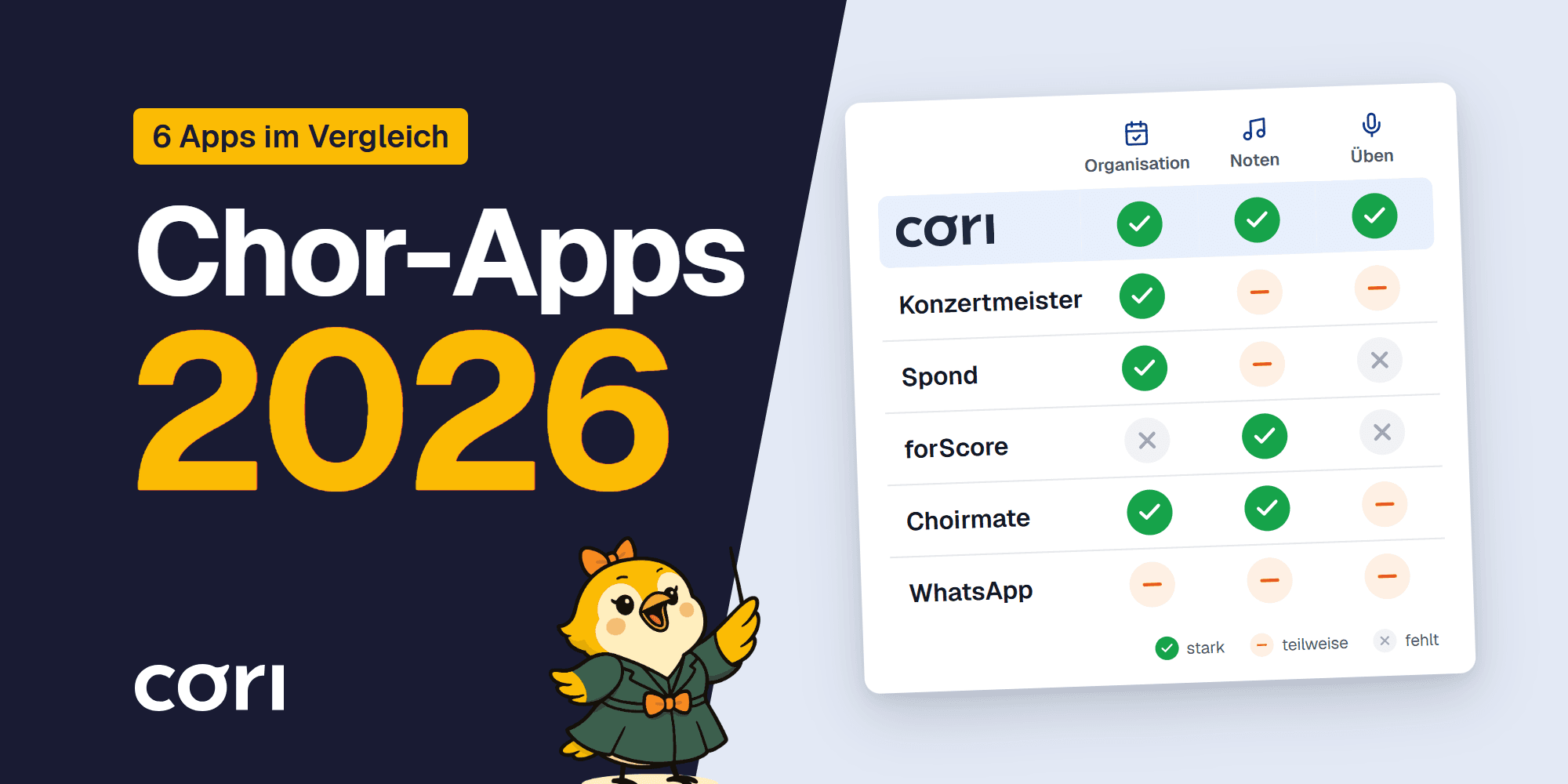
And if you then want to put concrete names side by side: the choir app comparison 2026 lines up six solutions from Konzertmeister to cori, with strengths, limits and a comparison table.
Want to see how cori can help your choir? Try cori free for 30 days and experience the difference. GDPR-compliant, no risk, with support in German from Karlsruhe. Do write to us if we can help you with the setup! :)
Get your choir ready for the future
So you can concentrate on what matters most: the music.
Share this article
More Articles
Choir Apps 2026 Compared
Choir apps 2026 compared: from Konzertmeister to cori – which app fits your choir? An honest review with clear recommendations for organization and practice.

The 6K practice room for the 2027 season: now in the browser too
6K UNITED! has opened the 2027 season, and cori's 6K practice room is ready: every song with chapter markers, follow-along lyrics and sheet music, groups and appointments for teachers, and for the first time in the browser as well, with nothing to install. What's new and how you get started.