
Practice recordings in the choir: How your singers really practice at home
February 19, 2026
•

Janina Moeller
Choir director since 2010When I think back to my first years as a choir director, we didn't have any practice recordings. The pieces were worked out in rehearsal, and anyone who wanted to practice at home picked the melody out on the piano or with a piano app – provided they could read music. For everyone else it meant: wait until the next rehearsal.
At some point I started exporting MIDI files from my notation software and sending them via WhatsApp. That was already a huge difference – suddenly everyone could practice at home, not just the music readers. Later I began singing individual voice parts myself. And again something changed: entrances landed faster, the tricky spots needed less rehearsal time, and we could start working on expression and dynamics earlier.
Ever since, I've been convinced: practice recordings are one of the most valuable tools between rehearsals – above all because they make practicing possible for everyone, regardless of how well they read music. And at the same time I've noticed that in most choirs – mine included – the full potential of practice recordings is nowhere near exhausted. With the right methods and tools, you can turn good practice recordings into great ones.
In this article I'm sharing what I've learned along the way – and what the research has to say about it.
Why practicing between rehearsals makes the difference
Plenty of choirs get along just fine without practice recordings – that's completely okay. But if you do use practice recordings (or are thinking about it), it's worth looking at what learning research knows about practicing. Because the potential is bigger than most people think.
Learning research is pretty clear on this: distributed practice – regular short sessions spread over several days – is markedly superior to so-called "massed practice" (everything at once). The so-called "spacing effect" is considered one of the best-documented findings in learning psychology. Cepeda et al. (2006) confirmed in a comprehensive meta-analysis of more than 300 experiments that distributed learning consistently leads to better results than compressed learning (Psychological Bulletin). That holds for vocabulary just as much as for motor skills – and singing is both: cognitive and motor work.
Translated to the choir, that means: One rehearsal a week is often not enough to learn the notes. Not because the rehearsal is bad, but because the brain needs time between sessions to consolidate what it has learned. If seven days pass between two rehearsals and nobody practices, the brain starts almost from scratch the next time.
And this is where perhaps the greatest advantage of practice recordings lies: they enable all singers to practice between rehearsals – including those who can't read music. In many choirs that's the majority. Without practice recordings, anyone who doesn't read music simply has no way to work on a piece at home. With a recording they do – and that changes rehearsal work enormously.
But practice recordings are valuable for two more reasons that often get overlooked:
Getting new members up to speed faster: Anyone joining a choir has to catch up on pieces the rest have been rehearsing for weeks. Without practice recordings, that's like jumping onto a moving train – with recordings, you can catch up calmly at home and walk into the next rehearsal prepared. Good practice recordings are therefore one of the most effective onboarding tools a choir can have.
Cushioning missed rehearsals: Illness, holidays, business trips – there's always a reason why someone is absent. Without practice recordings, those members quickly fall behind: whatever was worked out in the missed rehearsal stays a blind spot. With recordings they can catch up on what they missed and are back up to speed at the next rehearsal. That takes the pressure off everyone – both the absent members and the choir leadership, who would otherwise have to explain everything all over again.
So anyone already using practice recordings is doing a lot right. The interesting question is: how can you get even more out of them?
Your choir doesn't have practice recordings yet? Here's how to start
Many choir directors shy away from practice recordings because they think it's too much work. In reality there are quite different routes, and not every one of them requires a recording studio.
MIDI recordings: Already a huge step forward
MIDI recordings sound synthetic – but they are an enormous step forward compared to no practice recordings at all. Suddenly singers who can't read music can learn their voice part at home too. That alone noticeably changes rehearsal work.
Sometimes you get MIDI files supplied along with the sheet music – many publishers and online platforms offer them as supplementary material. If not, you can export them from notation software like MuseScore, Sibelius or Finale – per voice part or as a full sound. It's quick, it's free and it delivers exact pitches.
What MIDIs do well:
- Quickly available, no recording equipment needed
- Pitches and rhythm are guaranteed to be correct
- Individual voice parts are easy to isolate
- They enable practicing without music-reading skills – for many choirs that's the decisive point
Where MIDIs reach their limits:
- No phrasing, no expression, no breathing – they show which notes it is, but not how it should sound
- The synthetic voice can be harder for some people to follow than a human one
Still: if your choir has been working without practice recordings so far, MIDIs are a fantastic way in. Many choirs already get a lot further with them – and the effort is minimal.
Sung in by the choir leadership: More than just notes
My personal favourite – even though it means more work. When you as the choir leadership sing in a voice part yourself, you convey not only the right notes but also phrasing, dynamics, text pronunciation and musical intention. Your singers hear how you imagine the passage and can pick that up directly.
It doesn't have to sound perfect. On the contrary: a slightly imperfect but expressive recording is often more helpful than a sterile MIDI version. Your singers hear where you breathe, how you shape a phrase, where you deliberately get quieter. That's information no MIDI can deliver.
It matters to me that my recordings are as correct as possible – not perfect, but good enough that I'm happy with them. I don't re-record every little mistake, but the foundation should be right. A nice side effect: while singing them in, I immediately notice where the difficult spots are – and then I walk into the choir rehearsal perfectly prepared to give my singers exactly the right tips at those spots. If you want a bit more quality, you can use a simple USB microphone – but a phone microphone is absolutely enough to start with.
Professional teach-me tracks: High quality, high price
There are providers who produce professionally sung practice recordings for common choral repertoire (e.g. Cyberbass, Choralia, Hal Leonard). The quality is high, every voice part is available separately, and there are often versions with one voice part highlighted within the full sound.
The downside: this only works for standard repertoire. For your own arrangements or lesser-known pieces there are usually no ready-made tracks. And the costs can add up.
The mix is what does it
In practice I use a combination: for straightforward pieces, MIDIs are enough – whether supplied by the publisher or exported from the notation software. For difficult passages or pieces where the interpretation matters especially to me, I sing them in myself. And sometimes I combine the two – the MIDI version for the notes, my sung-in version for the expression.
What works well with MP3s – and where there's more to gain
If you send your choir practice recordings as MP3s via WhatsApp, email or a cloud folder, you're already doing a great deal right. Your singers have material, they can listen to the notes, sing along and prepare. That's a solid basis, and many choirs work well with it.
At the same time, there are a few questions a plain audio file alone doesn't answer:
- Where exactly do I start? (Was that bar 12 or 14?)
- Can I hear my voice part in isolation? (Or does my alto get lost between soprano and tenor?)
- Am I singing this correctly? (Without feedback, a bit of uncertainty remains)
- What exactly am I supposed to practice this week?
None of these are dealbreakers – but this is precisely where the potential lies that many choirs haven't tapped yet. Behavioural research shows that even reducing small hurdles (one click less, clearer orientation) significantly increases the likelihood of an action (Sheeran & Webb, 2016, Health Psychology Review). If you manage to lower those hurdles further, you turn occasional practicing into regular practicing.
How to get even more out of practice recordings
The goal isn't "more practicing at any cost", but rather: being able to start small, feeling progress quickly, and sticking with it regularly. There are a few levers that make the difference – from simple tips all the way to digital tools:
1. Make individual voice parts audible
When singers don't have clear orientation, uncertainty creeps in fast: "Am I singing correctly? Or am I just being thrown off by too many other voices?"
Many choir leaders solve this by mixing the recordings themselves – for example putting the target voice part noticeably louder than the others, or the target voice part in the left ear and the rest in the right (known as panning). That works and is already a big step. The downside: the mix is the same for everyone and it's fixed. Someone just starting out might like their own voice part even louder – someone who's already more confident wants to hear more of the full sound. And so choir leaders often send out several versions per voice part – one with just that voice part, one with tutti in the background – which quickly multiplies the workload.
An audio mixer solves both problems at once: every singer can mix for themselves while practicing – own voice part louder, the rest quieter, depending on what's needed at that moment. At first perhaps their own voice part at 100% and the others merely hinted at – later more of a tutti mix, to check how it works within the full sound. That way the choir leadership only has to provide recordings once, and the singers still get exactly the mix they need in that moment.
2. Short passages instead of whole pieces
"Practice the song" is too big. "Practice bars 12–20" is doable. And that's exactly how small practice sessions fit into everyday life.
As choir leadership you can prepare this deliberately: mark difficult entrances, name the tricky spots, highlight leaps. In a choir app like cori you can do that by section or bookmark – your members can then jump straight to those spots without scrubbing through four minutes of audio. But even without an app, a simple message helps: "Please practice bars 32–40, that's at 1:45 in the recording." That doesn't just save time – it turns "ugh, I don't feel like it" into "okay, 30 seconds I can manage".
The concept of "deliberate practice" (Ericsson et al., 1993, Psychological Review) suggests that targeted work on weak points is more effective than untargeted repetition. Anyone who keeps singing the whole piece from beginning to end usually stumbles over the same spot – anyone who works on precisely that spot gets confident faster.
3. Feedback while practicing
Anyone practicing at home with a recording is already doing a lot – but one question often stays open: "Am I actually singing this right?" Without feedback, a bit of uncertainty remains. You repeat a passage, you have a good feeling about it – and maybe only notice in the rehearsal that one note wasn't quite there.
According to Hattie (2009), feedback is one of the most influential factors for learning success – across every area of education (Visible Learning, Routledge). That transfers well to the choir: if you practice at home, you normally only get feedback at the next rehearsal – so once a week. Digital practice tools can narrow that gap.
cori's practice mode, for instance, shows singers in real time whether pitch and rhythm are right – like a quiet coach running alongside, without anyone feeling watched. You see immediately if you come in too early, miss a note or land off rhythm. The result: people who get feedback while practicing don't just practice with more motivation, but also more effectively – because uncertainties are cleared up right away instead of settling in until the next rehearsal.
4. Flexible practicing: sometimes focused, sometimes on the side
Not everyone practices the same way. And not every situation is the same. That's why it helps to have a choice:
- Focused: repeat difficult spots with feedback or slow the tempo down – perfect for those 10 minutes on the sofa in the evening.
- Just sing along: let the recording play in the car and sing along – the melody sticks while you're out getting bread rolls.
- Listen on the side: on a walk, on the bus, while doing the dishes, just let the recording run and hum along.
Learning research calls this "interleaving" and "variable practice" – and both work better than rigid repetition under always identical conditions. When practicing feels flexible, it doesn't get stuck waiting for the "perfect hour" that never comes. And that's exactly the point: use the small moments instead of waiting for the big practice session that never happens anyway.
Consistency without the nagging
Many singers already practice regularly with their recordings – but almost everyone also knows those weeks when it simply falls by the wayside. A stable routine doesn't come from good intentions alone, but from two things: reminders and rewards.
Reminders: a gentle nudge
Many people don't need drilling, just a reminder at the right time. A short "10 minutes for the alto part in 'Locus iste' this week?" is often enough to make it happen. That can be a message in the choir group, a reminder in the choir app, or simply a friendly note at the end of rehearsal.
Streaks and challenges: motivation that feels good
Gamification can quickly sound like gimmickry – but it isn't, if you use it right. With their Self-Determination Theory, Deci and Ryan showed that people are especially motivated when they experience competence (I'm getting better), autonomy (I decide when and how I practice) and social relatedness (I'm part of a team) (Ryan & Deci, 2000, American Psychologist).
A streak is nothing other than visible competence: I'm sticking with it. And a challenge is social relatedness: We're doing this together.
It works particularly well for choirs because it creates a group feeling – without putting anyone on the spot. Nobody sees who hasn't practiced. But everyone sees when the choir goal is reached. You don't practice out of pressure, but because you want to contribute to the team's success. And honestly? That works surprisingly well with adults too.
What a challenge can look like
The choir leadership picks songs (or marks just one section), sets a number of repetitions and optionally a shared choir goal. The members see the task and can tick it off. In a choir app like cori it's created in under a minute.
This week's challenge (20 minutes per person):
- Song 1: practice 0:45–1:10 three times
- Song 2: practice 1:55–2:40 three times
- Song 1 and Song 2 once each all the way through
Creating practice recordings: easier than you think
Creating practice material doesn't have to be complicated. Here's a pragmatic workflow that works for most choirs:
Option 1: Use MIDIs and score files
First check whether MIDI files are already supplied: many publishers and online platforms offer them as supplementary material alongside the sheet music. If not, you export them from your notation software (MuseScore, Sibelius, Finale). Exporting each voice part individually is no longer necessary for that:
- Export the whole score as one file: MIDI, MusicXML or the MuseScore file itself
- Upload it to a choir app that separates the voice parts for you. In cori you pick the file while creating the song: cori assigns the tracks to the voice parts, takes over the tempo and creates its own practice track for each voice part, which can be turned up and down in the mixer
- If a voice part sounds an octave too high or too low (typical for the tenor in treble clef), you correct that right during the import
Time needed: a few minutes per piece (or none at all if the file comes supplied). If your choir works without an app, you export each voice part individually as an audio file instead and share them via a cloud folder.
Option 2: Sing them in yourself
- First play in the piano (or a MIDI reference) – that's your foundation
- Then record each voice part individually – a phone microphone will do, a USB microphone is better
- At the start of the recording, briefly say which passage it is: "Alto, bars 32 to 48"
Time needed: 10–20 minutes per voice part and piece. More work, but considerably more helpful – especially for the musical shaping. And a nice side effect: if you sing them in yourself, you walk into the choir rehearsal absolutely well prepared, because you already know the difficult spots inside out.
Option 3: Record in the choir app
Some apps offer the option of creating practice recordings directly in the context of the song. In cori, for example, you can record straight in the app – the recordings land automatically with the right piece, can be controlled via the mixer and are immediately available to all members.
Distribution: how the material actually arrives
The best recording is worthless if nobody finds it. My most important piece of advice: reduce the number of clicks. The fewer steps between "I want to practice" and "I'm practicing", the more likely it is to happen.
- Ideal: one central choir app where all recordings are stored with the relevant piece – one tap and it plays.
- Good: a shared cloud folder (Google Drive, Dropbox) with a clear folder structure by piece and voice part.
- Okay: by message in the choir group – but then with clear labelling and ideally as a pinned message.
- Problematic: by email as an attachment. It disappears in the flood and is rarely found again.
The difference in rehearsal
When practice recordings really do get used, rehearsal work changes fundamentally. Instead of drilling notes for twenty minutes, you can work directly on dynamics, phrasing, expression and balance. The singers come prepared – not perfect, but with a solid foundation.
By now I notice the difference within the first five minutes of a rehearsal: when the entrances land on the first run-through and the notes are right, I know people have practiced. And then rehearsal is genuinely fun – for everyone. The singers feel that they can do something, and I can work musically instead of drumming notes into people. That's the moment when a rowdy bunch turns into a choir.
The effect is especially striking with new members and with people who missed a rehearsal: instead of feeling lost, they arrive prepared and can join in right away. Last year I had a new alto who said after her third rehearsal: "I never would have thought I'd settle in this fast – but with the recordings I could go through everything at home beforehand." Moments like that show that practice recordings aren't just a practice tool, but genuine bridges into the choir.
The most important points at a glance
Practice recordings don't have to be perfect – but they do have to be usable. The key success factors:
- Start simple: even a plain MIDI file is a huge step forward – it makes practicing possible for everyone, even without music-reading skills. You don't need a recording studio
- Think about new members and missed rehearsals: practice recordings help with onboarding and make sure nobody falls behind
- Choose the right format: MIDI for the notes, sung-in recordings for the expression – or a combination of both
- Give orientation: isolate individual voice parts, mark short sections, give clear instructions
- Enable feedback: visual coaching helps with learning – whether through an app or through targeted instructions from the choir leadership
- Make it flexible to use: in the car, on the sofa, on the go – the easier the access, the more often people practice
- Create motivation: reminders, streaks and challenges use the group feeling without building up pressure
When practicing between rehearsals works, you notice it straight away: rehearsals get more relaxed, the sound gets more confident, and you finally have time for the things that really make music what it is. Finding the right app for your choir can be an important step along the way – but even without an app it's worth thinking about the topic of practice recordings. Because in the end it isn't about the tool, it's about giving your singers the chance to keep developing between rehearsals.
Want to try out what practice recordings can look like in practice? In cori you can upload existing recordings or create them directly in the app, set up challenges for your choir and see how practice habits change. Try cori free for 30 days – with no commitment.
Get your choir ready for the future
So you can concentrate on what matters most: the music.
Share this article
More Articles
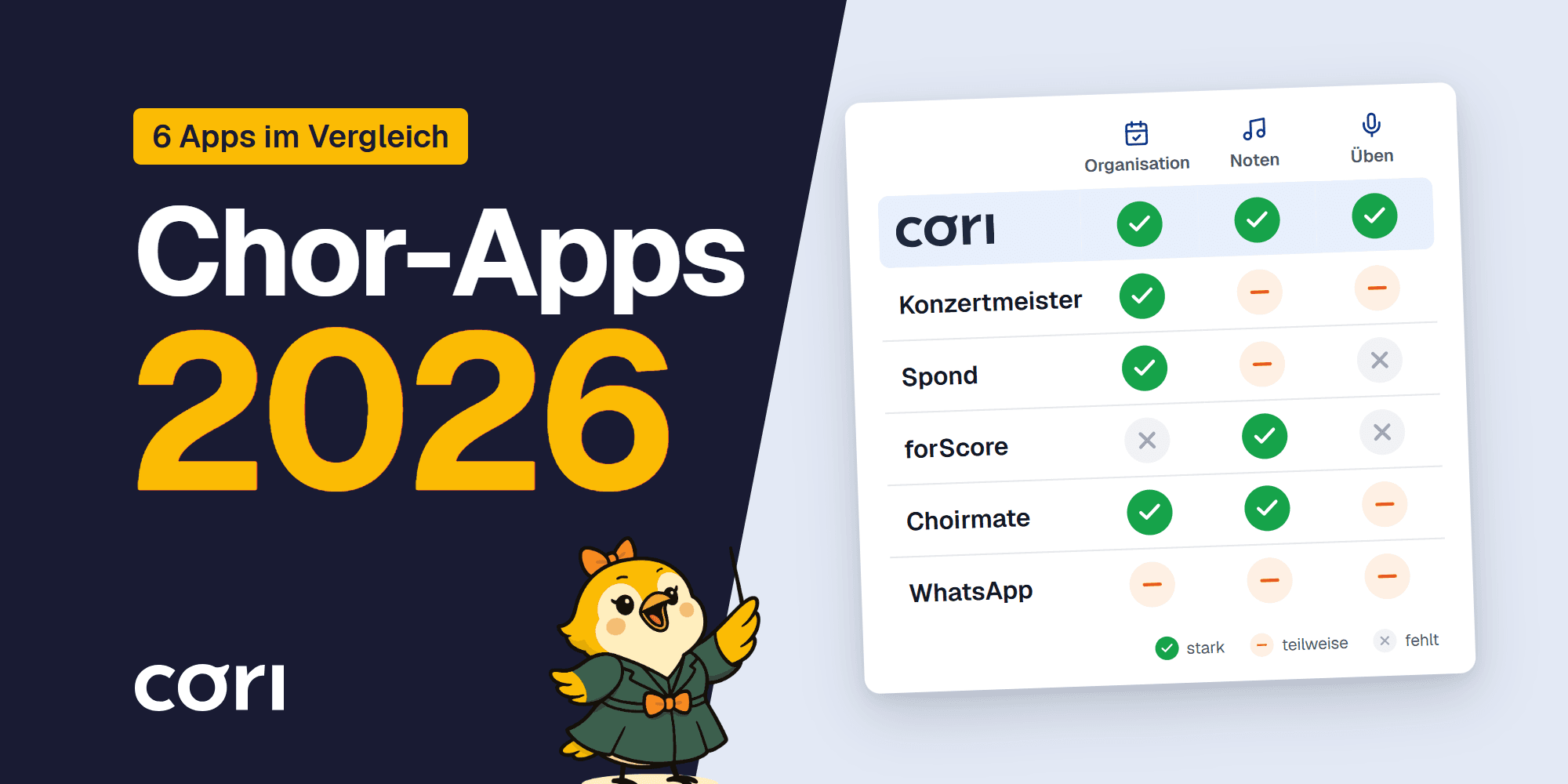
Choir Apps 2026 Compared
Choir apps 2026 compared: from Konzertmeister to cori – which app fits your choir? An honest review with clear recommendations for organization and practice.

The 6K practice room for the 2027 season: now in the browser too
6K UNITED! has opened the 2027 season, and cori's 6K practice room is ready: every song with chapter markers, follow-along lyrics and sheet music, groups and appointments for teachers, and for the first time in the browser as well, with nothing to install. What's new and how you get started.